Geometric Operations
This module provides common geometric operations for curves and surfaces. It includes the following operations:
Knot insertion, removal and refinement
Curve and surface splitting / Bézier decomposition
Tangent, normal and binormal evaluations
Hodograph curve and surface computations
Translation, rotation and scaling
Function Reference
- geomdl.operations.add_dimension(obj, **kwargs)
Elevates the spatial dimension of the spline geometry.
If you pass
inplace=Truekeyword argument, the input will be updated. Otherwise, this function does not change the input but returns a new instance with the updated data.- Parameters:
obj (abstract.SplineGeometry) – spline geometry
- Returns:
updated spline geometry
- Return type:
- geomdl.operations.decompose_curve(obj, **kwargs)
Decomposes the curve into Bezier curve segments of the same degree.
This operation does not modify the input curve, instead it returns the split curve segments.
- Keyword Arguments:
find_span_func: FindSpan implementation. Default:helpers.find_span_linear()insert_knot_func: knot insertion algorithm implementation. Default:operations.insert_knot()
- Parameters:
obj (abstract.Curve) – Curve to be decomposed
- Returns:
a list of Bezier segments
- Return type:
list
- geomdl.operations.decompose_surface(obj, **kwargs)
Decomposes the surface into Bezier surface patches of the same degree.
This operation does not modify the input surface, instead it returns the surface patches.
- Keyword Arguments:
find_span_func: FindSpan implementation. Default:helpers.find_span_linear()insert_knot_func: knot insertion algorithm implementation. Default:operations.insert_knot()
- Parameters:
obj (abstract.Surface) – surface
- Returns:
a list of Bezier patches
- Return type:
list
- geomdl.operations.derivative_curve(obj)
Computes the hodograph (first derivative) curve of the input curve.
This function constructs the hodograph (first derivative) curve from the input curve by computing the degrees, knot vectors and the control points of the derivative curve.
- Parameters:
obj (abstract.Curve) – input curve
- Returns:
derivative curve
- geomdl.operations.derivative_surface(obj)
Computes the hodograph (first derivative) surface of the input surface.
This function constructs the hodograph (first derivative) surface from the input surface by computing the degrees, knot vectors and the control points of the derivative surface.
The return value of this function is a tuple containing the following derivative surfaces in the given order:
U-derivative surface (derivative taken only on the u-direction)
V-derivative surface (derivative taken only on the v-direction)
UV-derivative surface (derivative taken on both the u- and the v-direction)
- Parameters:
obj (abstract.Surface) – input surface
- Returns:
derivative surfaces w.r.t. u, v and both u-v
- Return type:
tuple
- geomdl.operations.find_ctrlpts(obj, u, v=None, **kwargs)
Finds the control points involved in the evaluation of the curve/surface point defined by the input parameter(s).
- Parameters:
obj (abstract.Curve or abstract.Surface) – curve or surface
u (float) – parameter (for curve), parameter on the u-direction (for surface)
v (float) – parameter on the v-direction (for surface only)
- Returns:
control points; 1-dimensional array for curve, 2-dimensional array for surface
- Return type:
list
- geomdl.operations.flip(surf, **kwargs)
Flips the control points grid of the input surface(s).
- Keyword Arguments:
inplace: if False, operation applied to a copy of the object. Default: False
- Parameters:
surf (abstract.Surface, multi.SurfaceContainer) – input surface(s)
- Returns:
flipped surface(s)
- geomdl.operations.insert_knot(obj, param, num, **kwargs)
Inserts knots n-times to a spline geometry.
The following code snippet illustrates the usage of this function:
# Insert knot u=0.5 to a curve 2 times
operations.insert_knot(curve, [0.5], [2])

# Insert knot v=0.25 to a surface 1 time
operations.insert_knot(surface, [None, 0.25], [0, 1])

# Insert knots u=0.75, v=0.25 to a surface 2 and 1 times, respectively
operations.insert_knot(surface, [0.75, 0.25], [2, 1])

# Insert knot w=0.5 to a volume 1 time
operations.insert_knot(volume, [None, None, 0.5], [0, 0, 1])
Please note that input spline geometry object will always be updated if the knot insertion operation is successful.
- Keyword Arguments:
check_num: enables/disables operation validity checks. Default: True
- Parameters:
obj (abstract.SplineGeometry) – spline geometry
param (list, tuple) – knot(s) to be inserted in [u, v, w] format
num (list, tuple) – number of knot insertions in [num_u, num_v, num_w] format
- Returns:
updated spline geometry
- geomdl.operations.length_curve(obj)
Computes the approximate length of the parametric curve.
Uses the following equation to compute the approximate length:
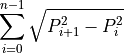
where
 is number of evaluated curve points and
  is the n-dimensional point.
- Parameters:
obj (abstract.Curve) – input curve
- Returns:
length
- Return type:
float
- geomdl.operations.normal(obj, params, **kwargs)
Evaluates the normal vector of the curves or surfaces at the input parameter values.
This function is designed to evaluate normal vectors of the B-Spline and NURBS shapes at single or multiple parameter positions.
- Parameters:
obj (abstract.Curve or abstract.Surface) – input geometry
params (float, list or tuple) – parameters
- Returns:
a list containing “point” and “vector” pairs
- Return type:
tuple
- geomdl.operations.refine_knotvector(obj, param, **kwargs)
Refines the knot vector(s) of a spline geometry.
The following code snippet illustrates the usage of this function:
# Refines the knot vector of a curve
operations.refine_knotvector(curve, [1])

# Refines the knot vector on the v-direction of a surface
operations.refine_knotvector(surface, [0, 1])

# Refines the both knot vectors of a surface
operations.refine_knotvector(surface, [1, 1])

# Refines the knot vector on the w-direction of a volume
operations.refine_knotvector(volume, [0, 0, 1])
The values of
paramargument can be used to set the knot refinement density. If density is bigger than 1, then the algorithm finds the middle knots in each internal knot span to increase the number of knots to be refined.Example: Let the degree is 2 and the knot vector to be refined is
[0, 2, 4]with the superfluous knots from the start and end are removed. Knot vectors with the changingdensity (d)value will be:d = 1, knot vector[0, 1, 1, 2, 2, 3, 3, 4]d = 2, knot vector[0, 0.5, 0.5, 1, 1, 1.5, 1.5, 2, 2, 2.5, 2.5, 3, 3, 3.5, 3.5, 4]
The following code snippet illustrates the usage of knot refinement densities:
# Refines the knot vector of a curve with density = 3
operations.refine_knotvector(curve, [3])

# Refines the knot vectors of a surface with density for
# u-dir = 2 and v-dir = 3
operations.refine_knotvector(surface, [2, 3])

# Refines only the knot vector on the v-direction of a surface with density = 1
operations.refine_knotvector(surface, [0, 1])

# Refines the knot vectors of a volume with density for
# u-dir = 1, v-dir = 3 and w-dir = 2
operations.refine_knotvector(volume, [1, 3, 2])
Please refer to
helpers.knot_refinement()function for more usage options.- Keyword Arguments:
check_num: enables/disables operation validity checks. Default: True
- Parameters:
obj (abstract.SplineGeometry) – spline geometry
param (list, tuple) – parametric dimensions to be refined in [u, v, w] format
- Returns:
updated spline geometry
- geomdl.operations.remove_knot(obj, param, num, **kwargs)
Removes knots n-times from a spline geometry.
The following code snippet illustrates the usage of this function:
# Remove knot u=0.5 from a curve 2 times
operations.remove_knot(curve, [0.5], [2])

# Remove knot v=0.25 from a surface 1 time
operations.remove_knot(surface, [None, 0.25], [0, 1])

# Remove knots u=0.75, v=0.25 from a surface 2 and 1 times, respectively
operations.remove_knot(surface, [0.75, 0.25], [2, 1])

# Remove knot w=0.5 from a volume 1 time
operations.remove_knot(volume, [None, None, 0.5], [0, 0, 1])
Please note that input spline geometry object will always be updated if the knot removal operation is successful.
- Keyword Arguments:
check_num: enables/disables operation validity checks. Default: True
- Parameters:
obj (abstract.SplineGeometry) – spline geometry
param (list, tuple) – knot(s) to be removed in [u, v, w] format
num (list, tuple) – number of knot removals in [num_u, num_v, num_w] format
- Returns:
updated spline geometry
- geomdl.operations.rotate(obj, angle, **kwargs)
Rotates curves, surfaces or volumes about the chosen axis.
- Keyword Arguments:
axis: rotation axis; x, y, z correspond to 0, 1, 2 respectively. Default: 2inplace: if False, operation applied to a copy of the object. Default: False
- Parameters:
obj (abstract.SplineGeometry, multi.AbstractGeometry) – input geometry
angle (float) – angle of rotation (in degrees)
- Returns:
rotated geometry object
- geomdl.operations.scale(obj, multiplier, **kwargs)
Scales curves, surfaces or volumes by the input multiplier.
- Keyword Arguments:
inplace: if False, operation applied to a copy of the object. Default: False
- Parameters:
obj (abstract.SplineGeometry, multi.AbstractGeometry) – input geometry
multiplier (float) – scaling multiplier
- Returns:
scaled geometry object
- geomdl.operations.split_curve(obj, param, **kwargs)
Splits the curve at the input parametric coordinate.
This method splits the curve into two pieces at the given parametric coordinate, generates two different curve objects and returns them. It does not modify the input curve.
- Keyword Arguments:
find_span_func: FindSpan implementation. Default:helpers.find_span_linear()insert_knot_func: knot insertion algorithm implementation. Default:operations.insert_knot()
- Parameters:
obj (abstract.Curve) – Curve to be split
param (float) – parameter
- Returns:
a list of curve segments
- Return type:
list
- geomdl.operations.split_surface_u(obj, param, **kwargs)
Splits the surface at the input parametric coordinate on the u-direction.
This method splits the surface into two pieces at the given parametric coordinate on the u-direction, generates two different surface objects and returns them. It does not modify the input surface.
- Keyword Arguments:
find_span_func: FindSpan implementation. Default:helpers.find_span_linear()insert_knot_func: knot insertion algorithm implementation. Default:operations.insert_knot()
- Parameters:
obj (abstract.Surface) – surface
param (float) – parameter for the u-direction
- Returns:
a list of surface patches
- Return type:
list
- geomdl.operations.split_surface_v(obj, param, **kwargs)
Splits the surface at the input parametric coordinate on the v-direction.
This method splits the surface into two pieces at the given parametric coordinate on the v-direction, generates two different surface objects and returns them. It does not modify the input surface.
- Keyword Arguments:
find_span_func: FindSpan implementation. Default:helpers.find_span_linear()insert_knot_func: knot insertion algorithm implementation. Default:operations.insert_knot()
- Parameters:
obj (abstract.Surface) – surface
param (float) – parameter for the v-direction
- Returns:
a list of surface patches
- Return type:
list
- geomdl.operations.tangent(obj, params, **kwargs)
Evaluates the tangent vector of the curves or surfaces at the input parameter values.
This function is designed to evaluate tangent vectors of the B-Spline and NURBS shapes at single or multiple parameter positions.
- Parameters:
obj (abstract.Curve or abstract.Surface) – input shape
params (float, list or tuple) – parameters
- Returns:
a list containing “point” and “vector” pairs
- Return type:
tuple
- geomdl.operations.translate(obj, vec, **kwargs)
Translates curves, surface or volumes by the input vector.
- Keyword Arguments:
inplace: if False, operation applied to a copy of the object. Default: False
- Parameters:
obj (abstract.SplineGeometry or multi.AbstractContainer) – input geometry
vec (list, tuple) – translation vector
- Returns:
translated geometry object
- geomdl.operations.transpose(surf, **kwargs)
Transposes the input surface(s) by swapping u and v parametric directions.
- Keyword Arguments:
inplace: if False, operation applied to a copy of the object. Default: False
- Parameters:
surf (abstract.Surface, multi.SurfaceContainer) – input surface(s)
- Returns:
transposed surface(s)